
Polyhouse Farming in India: The Complete Guide to High-Profit, Climate-Proof Agriculture
December 27, 2025
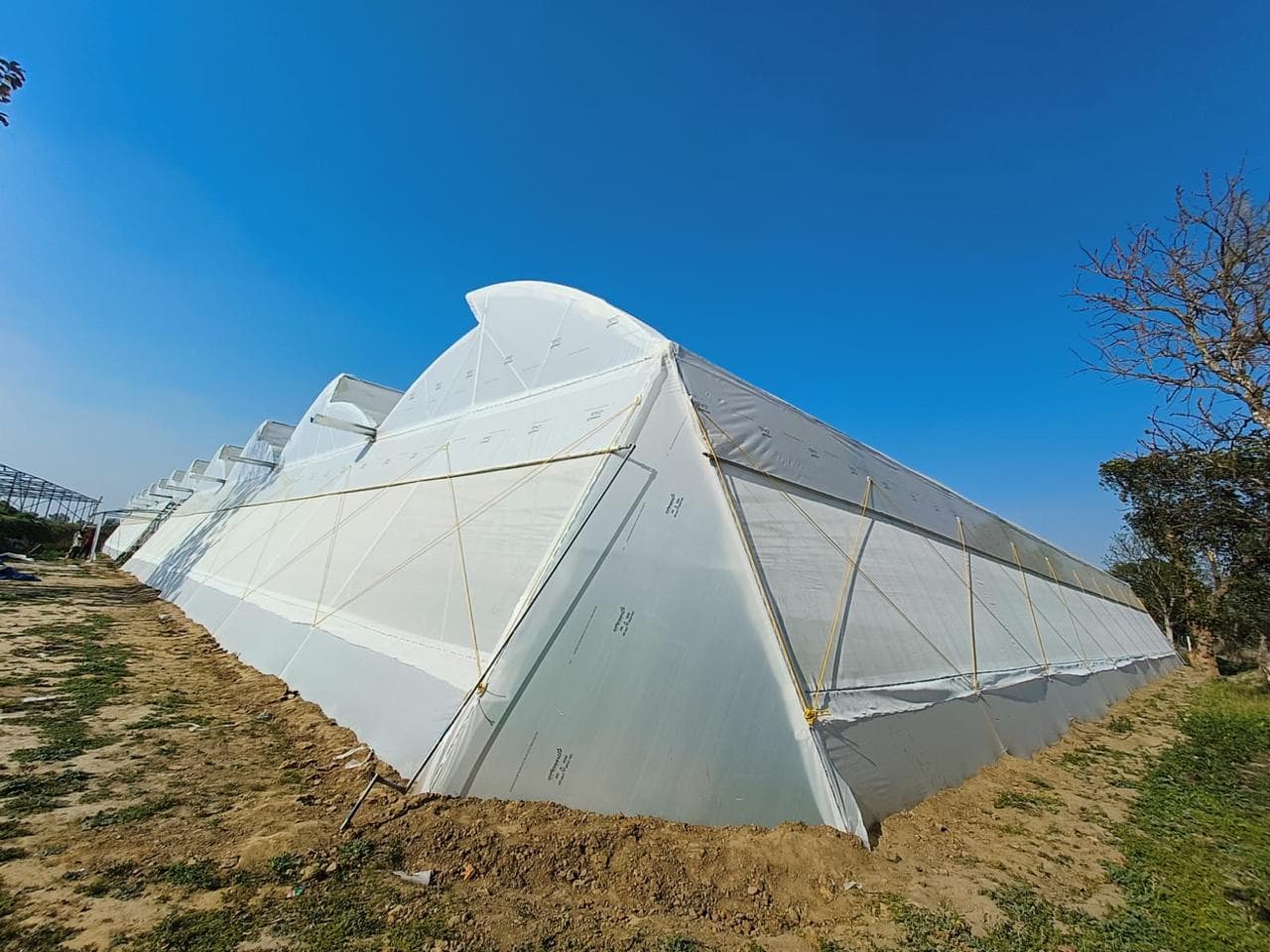
For generations, Indian farmers have battled the elements—unpredictable monsoons, scorching heat, unseasonal rains, and pests. What if you could take control of the climate?
For generations, Indian farmers have battled the elements—unpredictable monsoons, scorching heat, unseasonal rains, and pests. What if you could take control of the climate? What if you could grow premium cucumbers in Rajasthan’s peak summer or cultivate exquisite roses in heavy rainfall regions? This isn’t science fiction; it’s the everyday reality of polyhouse farming, a technology that is revolutionizing Indian agriculture.
Welcome. I’m your Agricultural Content Strategist & Polyhouse Expert. In this comprehensive guide, I’ll demystify polyhouse farming. Whether you’re a progressive farmer, an agripreneur, or an investor looking for a tangible, high-growth sector, this article will give you the clarity and confidence to take the next step.
What Exactly is a Polyhouse?
Think of it as a “Hospital for Plants” A polyhouse, often called a greenhouse, is a protective structure made of a polyethylene (poly) sheet cover over a steel or bamboo frame. Its primary job is to create a controlled micro-climate for optimal plant growth, irrespective of the external weather.
Simple Analogy: Just as an ICU provides the perfect temperature, humidity, and sterile environment for a critical patient, a polyhouse provides the ideal environment for high-value crops. You control the “weather” inside.
How Does a Polyhouse Work?
The Science Made Simple the core principle is the Greenhouse Effect. Sunlight (shortwave radiation) enters through the transparent poly sheet, heats the plants, soil, and equipment inside. This heat is re-radiated as longer-wave infrared radiation, which cannot easily escape through the poly sheet, thus trapping warmth.
But a modern polyhouse is more than just a warm shell. It’s a system:
Skeleton (Frame): Made of Galvanized Iron (GI) pipes for durability. Low-cost models can use bamboo.
Covering (Cladding): UV-stabilized polyethylene film (usually 200 microns). For higher investment, polycarbonate sheets are an option.
Ventilation: Natural (side and roof vents) or fan-pad systems: where exhaust fans on one wall and cooling pads on the opposite create a cool breeze.
Irrigation: Drip Irrigation is non-negotiable. It delivers water and dissolved fertilizers (fertigation) directly to roots, saving 60-70% water.
Climate Control: Manual or automated systems for shading (nets), misting (for humidity), and heating (in cold regions).
Why Polyhouse Farming?
The Compelling Profit Proposition. Let’s move from “how” to “why.” Here’s where your interest turns into excitement.
1. Unbeatable Yields: Open-field tomato yield: 15-20 tonnes/hectare. Polyhouse tomato yield: 80-120 tonnes/hectare. The numbers speak for themselves. Controlled conditions mean less plant stress, continuous growth, and longer cropping cycles.
2. Premium Quality & Off-Season Production: Grow bell peppers in rainy season when market prices triple. Produce export-quality, blemish-free gerbera flowers. Quality commands premium prices in elite markets, hotels, and export companies.
3. Dramatic Resource Savings:Water: Drip + covered soil reduces evaporation. Save up to 70%.* Fertilizers: Fertigation ensures 80-90% efficiency vs. 30-40% in open field.* Pesticides: Protected environment reduces pest/disease incidence by over 60%. Enables integrated pest management (IPM).
4. Climate Insurance: No more crop loss due to hail, heavy rain, or heatwaves. Your investment is physically protected.
What Can You Grow?
(Cropping Choices for Maximum ROI)Your choice of crop is your profit decision. Here’s a breakdown:
Vegetables (Highest Demand): Colored Capsicum (Bell Peppers), Cherry Tomatoes, Cucumber (European), Lettuce, Broccoli. These have stable, high demand in metro cities.
Flowers (High-Value, Export Potential): Gerbera, Roses (Dutch varieties), Carnations, Lilium. Floriculture under polyhouse is a cash-intensive but extremely rewarding model.
Fruits & Others: Strawberries, exotic herbs (Basil, Mint), medicinal plants (Stevia).
Pro Tip for Beginners: Start with capsicum or cucumber. They have a relatively shorter growing cycle, high yield, and established market demand. Move to flowers once you have operational experience.
Types of Polyhouses:
Choosing Your Structure|Type | Key Feature | Best For | Estimated Cost (₹/sqm)* || ---- | ---- | ---- | ---- ||Naturally Ventilated | Side & roof vents for manual climate control | Beginners, regions with moderate climates | 800 - 1,200 ||Fan-Pad Cooled |Active cooling & ventilation. | Exhaust fans + wet pads. | Hot & dry climates (e.g., Rajasthan, Gujarat). | 1,400 - 1,800 ||Shade Net House | Polyester/alu shade net (50-75% shade). | Nurseries, foliage plants, partial shade crops. | 400 - 700 ||Insect Net House | 40-50 mesh insect-proof net. | Organic vegetable production, virus-free cultivation. | 600 - 900 |
Costs are indicative for structure & cladding. Vary with automation, location.
The Heart of the Matter: Cost, Subsidy & ROI in IndiaThis is the section you’ve been waiting for. Let’s talk numbers with a practical example.
Project: 1-Acre (4000 sqm) Naturally Ventilated Polyhouse for Colored Capsicum
Capital Cost (Approx.): ₹ 40-50 Lakhs (₹1000-1250/sqm). Includes structure, drip, fertigation, basic infrastructure.
The Game-Changer:
Government Subsidy in India, polyhouse farming is promoted under NHM (National Horticulture Mission), MIDH, and state schemes. Subsidy ranges from 50% to 75% for small/marginal farmers and 25-50% for others, depending on state.*Potential Subsidy (approx.): ₹ 15-25 Lakhs.*Your effective project cost can drop to ₹ 20-30 Lakhs.
Operational Cost (Per Year): Seeds, fertilizers, labour, electricity, etc.: ₹ 5-7 Lakhs.
Revenue & Profit (Per Year):
Yield: 3-4 crops, ~120-150 tons/acre.
Avg. Market Price: ₹ 30-60/kg (varies with season/quality).
Gross Revenue: ₹ 36-90 Lakhs.
Net Profit (Pre-Tax): ₹ 25-40 Lakhs/acre/year (after operational costs and accounting for capital depreciation).
The ROI Breakthrough: With subsidy, your net investment of ~₹25 Lakhs can generate a net profit of ~₹30 Lakhs in Year 1 itself. Even without subsidy, the payback period is typically 2-3 years. No other farming model offers this.*
Navigating Risks: Be Smart, Not ScaredEvery venture has risks. The smart farmer manages them.
Technical Know-How Gap: This is the biggest risk. Solution: Partner with an expert agronomist or a turnkey service provider. Do not rely on trial and error.
Market Fluctuations: Off-season produce buffers this. Solution: Tie-up with collection centers, FPOs, or exporters before planting.
Initial Investment: Subsidies bridge this. Solution: Approach your District Horticulture Officer for precise scheme details. Prepare a detailed project report (DPR).
Pest/Disease Outbreak: Controlled environment minimizes this. Solution: Implement strict sanitation, use disease-resistant varieties, and monitor crops daily.
Your First Steps: How to Start Your Polyhouse JourneySelf-Education: You’re doing it right now. Keep researching.
Land: Secure at least 0.5 to 1 acre with a reliable water source and electricity.
Business Plan: Decide on crop, type of polyhouse, market.
Visit Successful Farms: Nothing beats seeing a working model. I can help guide you on what to look for.
Government Liaison: Apply for subsidy approval before starting construction.
Choose the Right Partner: Select a reputable polyhouse construction company with agronomy support. Don’t just go for the cheapest quote.
Conclusion:
The Future is Under Cover Polyhouse farming is not just farming; it’s agri-business. It’s for those who see land as a factory for producing high-value, year-round products. It transforms agriculture from a gamble with nature into a predictable, science-driven enterprise.
The question is no longer “Can I do it?” but “When will I start?”
Ready to Turn This Knowledge into Your Success Story?
You now have the blueprint. But every farm, every region, and every farmer’s ambition is unique. You need a plan tailored to your land, your budget, and your market.
That’s where my expertise comes in.
As your Polyhouse Expert, I help farmers and investors like you move from confusion to clarity, and from planning to profit.